Wagah Border Ceremony: What to Expect — A First-Timer’s Complete Guide
Experiencing the Wagah Border ceremony first time is genuinely hard to describe. A crowd of thousands on the Indian side, synchronized marches, high kicks, and a flag-lowering that ends in absolute silence make it unforgettable. It’s theatrical, patriotic, and oddly moving — even for visitors with no particular connection to either country. Here’s what first-timers need to know before they go.
What Is the Wagah Border Ceremony?
The Beating Retreat ceremony takes place every evening at the Attari Wagah Border — the main land crossing between India and Pakistan, roughly 28–32 km from Amritsar. It began in 1959 as a simple military protocol: both sides lower their respective national flags simultaneously each evening before the gates close for the night. Over the decades it evolved into a full performance, with coordinated footwork, exaggerated high kicks, chest-puffing marches, and a crowd of thousands on each side cheering, waving flags, and (on the Indian side) occasionally breaking into impromptu dancing before the ceremony starts.
It happens every single day of the year, including holidays.
What Actually Happens, Start to Finish
Before the Ceremony (1–2 hours before start)
The viewing galleries begin filling up well before the ceremony itself. There’s usually a warm-up period in which music plays and the crowd builds energy — on the Indian side, this often involves people dancing near the gate area and waving large Indian flags. It has the atmosphere of a stadium event before the main act.
The Ceremony Itself (roughly 30–45 minutes)
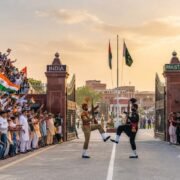
Soldiers from India’s Border Security Force (BSF) march out to the gate in sequence — elaborate high-stepping kicks, synchronized movements, dramatic pauses designed to impress both the home crowd and their counterparts across the border. Pakistani Rangers perform a mirror version on their side simultaneously. The two sets of soldiers meet at the gate, exchange a brief formal acknowledgment, and then both national flags are lowered in tandem — never one before the other.
The Flag-Lowering
This is the moment most visitors remember longest. Both flags come down at exactly the same speed, folded by the respective soldiers, and the gates close simultaneously. The crowd falls notably quieter than it was during the high-energy marching. It’s a few seconds of real gravity amid all the theatre.
After the Ceremony
Crowds start dispersing immediately — the gates don’t open for general crossing, and the grounds clear fairly quickly. This is when your pre-arranged taxi matters: having a driver waiting means you leave before the exit traffic bottleneck rather than being stuck in it.
If you are visiting for the Wagah Border ceremony first time, planning your transportation ahead of time prevents traffic bottlenecks.
Practical Things to Know
What to Bring
A valid photo ID — mandatory for entry, no exceptions.
Water — particularly in summer, when you may be sitting in direct sun for 1–2 hours before the ceremony.
Light layers for winter visits — evenings near the border can be surprisingly cold in December and January.
A small bag only — large bags go through security checks and slow you down significantly. Leave non-essentials in your taxi.
What Not to Bring
Drones or professional camera equipment — not permitted near the border area.
Anything that looks remotely like recording equipment beyond a smartphone — security is thorough and sometimes unpredictable about what they flag.
What to Wear
There’s no strict dress code, but the ceremony draws a patriotic crowd and dressing respectfully is the norm. Comfortable walking shoes matter more than anything — you’ll be walking from the parking area and standing or sitting on bleacher-style seats.
Photography
Photographing the ceremony from the gallery is generally permitted with a smartphone or personal camera. Rules on the Pakistani side are reportedly stricter — don’t photograph toward the border gate itself without observing what the crowd around you is doing, and follow security directions immediately if asked.
Seating
There are covered galleries (some reserved for women and families) and open areas. Covered seats tend to fill faster — arriving 1.5–2 hours early is the difference between a clear view and a partial one. See our guide to arrival timing for the seasonal breakdown.
Common First-Timer Questions
Yes — the ceremony happens every single day, including national holidays (which actually bring larger, more energetic crowds if that’s what you’re after).
Completely. The border area is one of the most heavily managed tourist sites in Punjab, with security checkpoints, uniformed personnel throughout, and large organized crowds. It’s a well-established tourist destination, not a restricted border zone.
No — the Wagah crossing is not open for general tourist use. You’re watching the ceremony from the Indian side only.
Yes — the crowd energy, the music, and the spectacle make it genuinely engaging for kids. The walk and the wait beforehand are the only challenges for very young children.
Budget roughly 4–5 hours for a round trip from central Amritsar — about an hour each way plus 2 hours at the site.
How to Get There
The most reliable way is a pre-booked private taxi from Amritsar, timed around the ceremony schedule. Our Wagah Border Ceremony Booking covers exactly this — a round trip with an experienced driver who already knows today’s start time and the best time to leave. If you’d like to combine the ceremony with the Golden Temple and other sightseeing, our Amritsar Full Day Tour builds the whole day around the ceremony schedule.
First time in Amritsar and not sure how to plan the day? Contact us and we’ll help you put together an itinerary that works around your timings.